Current modeling techniques for building a reservoir model involve first constructing the top and bottom surfaces of the reservoir and then linking them with pillars (also referred to as columns) to create a three-dimensional (3D) gridded volume. Inside the pillars are a collection of cubic cells that are deformed to fit horizons and which run in directions parallel to faults. The grids are structured and require the same number of cells in each row or column.

The construction of fault pillars is typically a manual or semiautomatic process, which becomes increasingly complex and technically limiting as the complexity of fault structures increases. Furthermore, the need to construct pillars one at a time places significant limits on the consistency of the 3D model.
“Essentially, these grids become very difficult to construct if the geology becomes too complex,” Gringarten said. “If you do manage to construct them, then the cells may become quite deformed if the faults are nonvertical. This deformation of the grid becomes a problem for flow simulators, leading to numerical errors because of the nonorthogonality of cells.
“What we have traditionally done is move from a two-dimensional (2D) space to 3D,” he continued. “When we constructed a corner-point geometry grid, it was essentially an extrusion from the 2D surface, such as from the top to the base. With SKUA, however, we are moving into a true 3D space.”
SKUA enables the user to obtain a native, complete 3D description of faulted volumes, where horizons and grid geometries are constructed simultaneously in the 3D space. SKUA draws on Paradigm’s UVT Transform technology, which is based on the observation that horizons represent geochronologic surfaces, to create these horizons and grid structures.
“What we have in SKUA is an underlying 3D parameterization of the space,” said Gringarten. “It is this space that we will discretize, and it can be seen as a deposition space without the artifact of previous grid construction problems. In this space we can model geobodies, reservoir properties, and other attributes in their true depositional states, and then project the result back into the real space with no deformation due to the grid… we can do this regardless of the complexity of the structure, and with no distortion to either the current geometry or the paleo-geometry.”
SKUA provides flexibility, time and cost savings
The technology can then be used to construct a flow simulation grid stair-stepping at fault location. “The advantage of this grid system is that you are able to represent the complete structure of the reservoir, and also have cells that are as orthogonal to each other as they can be,” Gringarten said.
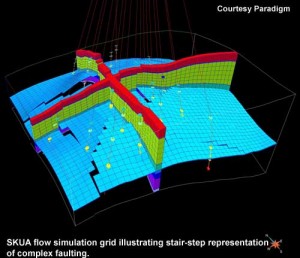
SKUA enables output of two grids to satisfy the different requirements for modeling geologic grids and flow simulation grids. The geologic grid will be optimized for geostatistics, while the flow simulation grid will be optimized for flow simulators and can have faults represented either as pillars or as stair-steps across mostly vertical pillars. Conventional pillar-based applications, by contrast, typically provide only one grid which is not optimal for either purpose.
SKUA can be run on both Linux and Windows and uses seismic, geological, and petrophysical interpretation data to develop the model. “SKUA uses and honors all the data,” said Gringarten, “and one advantage is that it will show you straight away if you have inconsistencies in your interpretation. Some of the inconsistencies can be removed fairly quickly within SKUA… you can remove bad data, change a fault type if you think it was reversed, and so on.”
In addition to providing more accurate models, SKUA also provides significant time savings versus pillar-based applications. “From the outset, SKUA allows you to construct a model of complex reservoirs in a matter of hours. With previous methods, it might take weeks to construct just the structural model, and then additional weeks to decide what faults to remove from the data set, because they could not be accounted for in the grid.”
The time savings afforded with SKUA provides several additional benefits to the operator. For example, significant cost savings may be realized because geoscientists are able to provide meaningful data in a fraction of the time required for previous model-building software tools. Geoscientists can now concentrate on understanding the reservoir and the range of possible scenarios, which can lead to reduced risk in the field and potentially fewer dry wells being drilled.
As more data becomes available about the field and the reservoir, the geoscientist can easily update the model in SKUA to obtain a more accurate grid for improved decision making. “All of the data can be included, because SKUA can handle this level of complexity without having the geoscientist resort to biased editing of geologic information to make the model run,” said Duane Dopkin, Senior Vice President of Technology for Paradigm.
“The ability of SKUA to ‘trap’ interpretation errors during the modeling stage is an important concept, introduced some time ago in geologic structural restoration programs,” Dopkin continued. “The modification here is that all of the transformation is done at the paleological or depositional state. Using different transformations to obtain different perspectives on a legacy problem is what makes SKUA so powerful, and this is an approach we will apply to many of our other emerging technologies.”
 發布信息
發布信息