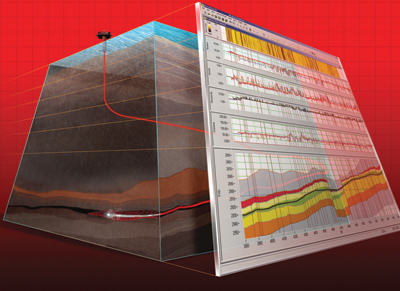
A ‘point the bit’ system has proven useful in difficult formations. (Images courtesy of Halliburton)
As existing fields in the Asia-Pacific region are developed and the search for new reserves continues, there is and will continue to be focus on reducing operating costs.
However, these costs must not be reduced to a point that the overall value of the asset is diminished by, for example, compromising the amount of recoverable reserves accessed just to increase overall drilling rates by a few days.
Operators and service companies have made huge strides in recent years in reducing operating costs, not only with the implementation of new technologies, but also by redefining roles and relationships and the resulting processes within the teams developing the assets.
There has been a rapid uptake by operators in the Asia-Pacific region of many of the new technologies that have been introduced in recent years to improve drilling efficiency. New technologies have been introduced in the areas of drilling technology and logging-while-drilling (LWD) sensors, and there has also been a widespread uptake of real-time operations.
One area where new technology has been focused is in the actual drilling process. To access additional reserves in existing fields and new reserves found in less accessible locations throughout the Asia-Pacific area, increasingly complex well designs are being planned and drilled.
A large amount of industry non-productive time in the drilling process has historically been attributed to hole problems, and there are many reasons for this - unstable formations, reactions between formations and the drilling fluids, poor directional control, key seating, etc. In recent years, however, evidence has begun to suggest that there was another reason ? borehole spiraling.
As long ago as the 1950s the effects of “sinusoidal” borehole rugosity on the response of certain wireline tools was being reported. More recently, the use of borehole imaging tools has provided more direct evidence of borehole spiraling. The cumulative effect of this spiraling when it occurs over thousands of feet adversely impacts overall drilling efficiency, creating:
● Increased torque and drag;
● High downhole vibration;
● Decreased downhole tool reliability;
● Poor hole cleaning;
● Reduced borehole drift; and
● Reduced bit life.
To reduce this spiraling effect, the stabilization of the drill bit needs to be increased or the side cutting action needs to be reduced, or preferably both. Extended-gauge bits offer a partial solution, but there has been a certain amount of resistance to using a long-bit gauge to stabilize the bit in directional wells. A matched-drilling system of an extended-gauge bit and a specially modified mud-motor was originally designed to overcome these problems, and the findings from this system were used in the Geo-Pilot XL Rotary Steerable System (RSS), which uses a deflected drive shaft that results in an angle change of the bit itself relative to the RSS housing. This “point-the-bit” concept allows the use of the long-gauge bits.
The Geo-Pilot system is now used throughout the Asia-Pacific region in a variety of drilling environments, including:
● Offshore extended-reach drilling well - more than 10,170 ft (3100 m) of 171⁄2-in. hole section drilled in a single run;
● Onshore complex geology - a single run of more than 4,200 ft (1,300 m) in highly tilted formations while building from vertical to a near horizontal landing point;
● Unique “hook” wells - final sections drilled “uphill” to 127° inclination; and
● Offshore thin, complex reservoir - geosteered intervals remaining within a narrow 3-ft (1-m) corridor.
One striking feature demonstrated by the system is the ability to control and build angle in “soft” or friable formations prone to wash-out. With a conventional RSS, the “push-the bit” principle requires a competent formation to push against. Conversely, the point-the-bit principle of the Geo-Pilot system has been used to kick off from vertical and build angle successfully in the soft formations typically encountered in deepwater wells such as those off the Northwest Shelf of Australia and in the South China Sea. In one unique application in a deepwater well, an operator used a Geo-Pilot GXT system, which incorporates an even-walled GeoForce motor power section, to run a 30-in. surface casing stream and then drill a 26-in. hole while maintaining directional control and building angle as planned.
LWD technology has seen a huge growth in sensor development over the past five years and is now applied routinely in many if not most offshore wells in Asia-Pacific. Whereas five years ago running additional sensors beyond the standard “triple-combo” suite was seen as unusual, it is now routine to see such LWD sensors as density imaging devices and sonic sensors as integral parts of the bottomhole assembly. As the range of LWD sensors continues to increase in availability, it is now possible to replace many equivalent wireline logging runs, which in today’s increasingly expensive offshore environment can result in significant costs saving for the operator.
Recent examples of the use of the advanced formation evaluation sensors in the region include:
● Almost 50 successful tests taken by the 8-in. GeoTap Plus formation pressure tester in one hole section;
● High-resolution formation resistivity images acquired by the InSite AFR Azimuthal Focused Resistivity sensor;
● Large-hole sonic data acquired by the BAT sonic LWD tool; and
● Nuclear magnetic resonance data acquired by the MRIL-WD tool.
These latest LWD sensor developments result in an increase in the amount of data that needs to be transmitted. Special wired drill pipe that can transmit at rates of up to 57,000 bps was recently run in Asia-Pacific. This showed dramatic improvements in real-time log resolution even at very high drilling rates.
Many operators are now also using real-time operations on a routine basis, whereby data from their drilling operations is streamed continuously into their offices, usually into a central, specially designed collaborative environment. Here, key decision-makers from the operator can work with experts from the service company (such as geosteering engineers and drilling optimization experts) to make the decisions required to optimize drilling performance, well placement, and safety in a rapid and timely manner.
When combined, these technologies have a significant impact on the ability to develop access to difficult reserves. In one recent example, the RSS was used to drill a difficult 121⁄4-in. hole section involving an initial drop with a turn followed by a build with another turn.
The real-time images from the azimuthal-gamma-ray-at-bit sensor, only 3 ft (1 m) from the bit, provided invaluable structural data to confirm that the hole was landed accurately in the target reservoir. To ensure an optimal wellbore placement in the reservoir, pre-well planning and forward modeling of the anticipated LWD log responses was performed with the StrataSteer3D geo-steering application. Primarily, the resistivity sensor data were utilized for active geosteering and supplemented with the ALD Azimuthal Density imaging sensor. The real time azimuthal at-bit gamma-ray image was of sufficiently good resolution to provide early structural interpretation.
Using the precise directional control afforded by the RSS, it was possible to optimally steer to position the well bore within the different targets in the reservoir. Any borehole spiraling would have severely reduced the resolution of the real-time azimuthal image; recorded LWD data confirmed the quality of the borehole drilled by the system, with no evidence of any spiraling.
During the whole drilling program, the drilling parameters and LWD petrophysical logging data were streamed into the operator’s office via real-time data transmission. This was essential in the decision-making process and pivotal to the success of the job during the close collaboration among all personnel involved in the geo-steering process.
 發(fā)布信息